 3 Nov 25
Writing a good blog post is the hard part. Squeezing five channels of content out of it should be the easy part, and with a repeatable workflow it is. Here is the exact process we use.
Most teams treat a blog post as a single deliverable. They spend a day writing it, publish it, share it once, and move on to the next one. That is an enormous waste, because the expensive part, the thinking and the writing, is already done. The cheap part, turning that one piece into a week of content across five channels, is the part almost nobody does, and it is where most of the return actually lives.
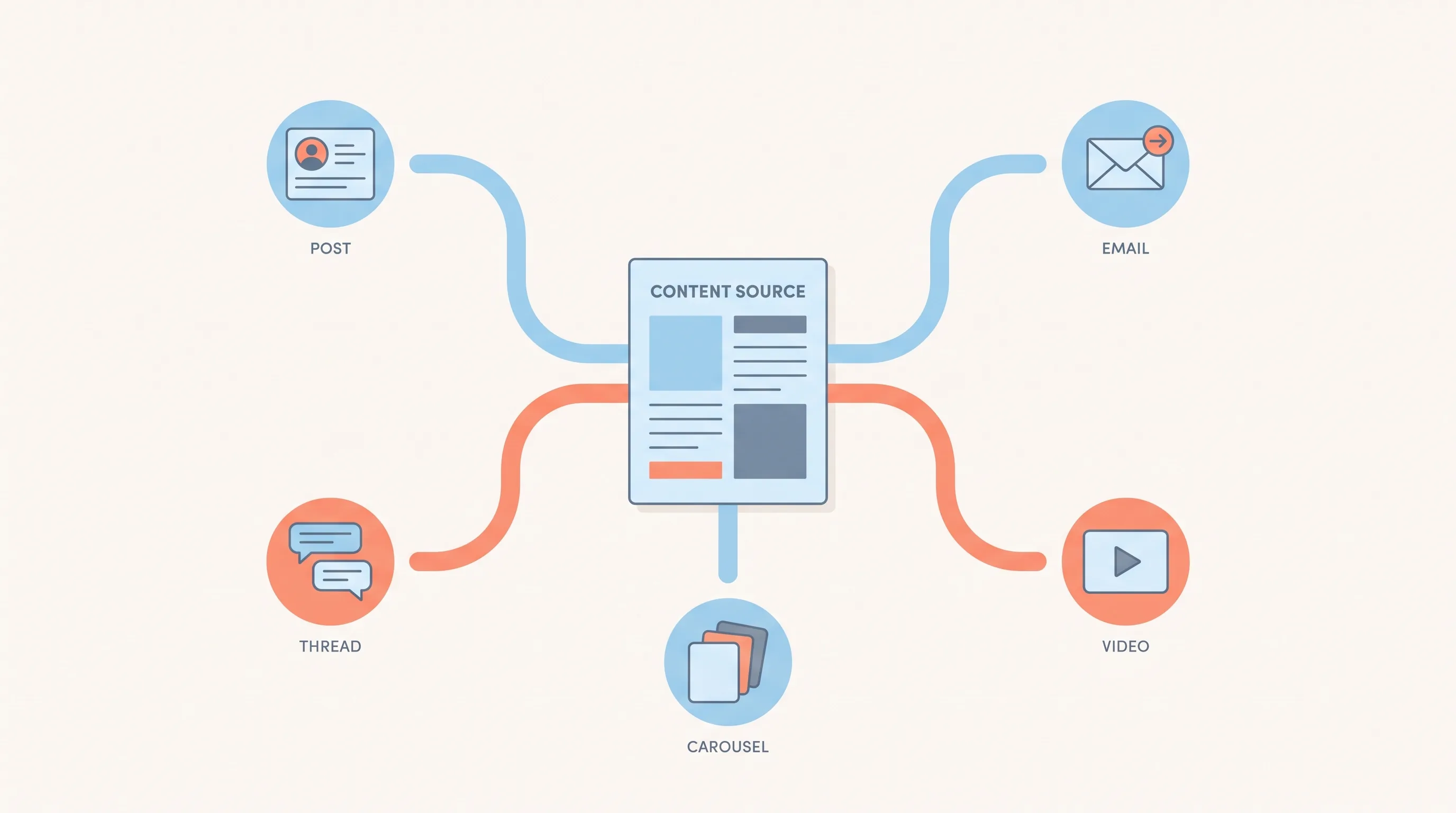
The reason people skip it is not laziness. It is that repurposing feels like five new jobs. It only feels that way because there is no workflow. With one, a published post becomes five channels of content in an afternoon. Here is the exact process.
First, Write the Post to Be Repurposed
The workflow starts before the post is even written. If you write a blog post as one indivisible essay, it resists being broken up. If you write it as a spine of clear, self-contained points, each section becomes a repurposing seed on its own. This is not extra work, it is just structure: a strong headline, a handful of sections that each make one point cleanly, and a clear takeaway. A well-structured post is a repurposing machine; a rambling one is a dead end. Everything below assumes the post has that spine.
The Five Channels, in Order of Effort
The trick is to work from lowest effort to highest, so momentum carries you. Each channel is a transformation of material you already have, not a new creation.
Channel one: the LinkedIn or long-form social post. Take the single sharpest point in the article, the one insight that made the post worth writing, and rewrite it as a standalone post that delivers that one idea and links back for the rest. You are not summarising the whole article, you are extracting its best moment. This is the highest-return repurpose, because it meets people where they already are.
Channel two: the email. Your newsletter version is not a copy of the post, it is a personal-voiced note that frames why this topic matters right now, gives the reader the core takeaway, and points them to the full piece if they want depth. The post supplies the substance; the email supplies the reason to care today.
Channel three: the short-form thread or carousel. The sections of a well-structured post map almost one-to-one onto the slides of a carousel or the beats of a thread. Each section becomes one card or one line. This is the most mechanical transformation of all, which is why it belongs in the middle: it is fast once the post exists.
Channel four: the short video or audio. You do not need a studio. Talking through the post’s main argument to a camera or a microphone for two minutes produces a clip, and the post is your script. The thinking is done; you are just saying it out loud. This is where AI tools genuinely help, and it is the sort of task we sort carefully when deciding which tools actually earn their place.
Channel five: the evergreen asset. The highest-effort, highest-durability repurpose: fold the post into something permanent, a resource page, a guide, an internal-link hub that keeps sending traffic to the piece long after the social posts have scrolled away. This is the one that compounds.
Make It a System, Not a Heroic Effort
The reason this works as an afternoon and not a week is that it is a checklist, not a series of creative decisions. Same five channels, same order, every time. You are not deciding what to make, you are executing a known transformation on new material. That is exactly what turns a good idea into a repeatable workflow that runs without a hero carrying it each time.
Build a simple template for each channel, a LinkedIn skeleton, an email skeleton, a carousel layout, and repurposing stops being a fresh act of will and becomes a form you fill in. The template is the whole difference between “we should repurpose more” and actually doing it every week.
The Mistake That Ruins Repurposing
There is one way to do this badly, and it is worth naming because it is the default failure. Repurposing is not copy-pasting the same paragraph onto five platforms. A blog excerpt dumped verbatim into LinkedIn, then again into an email, then again as a caption, reads as lazy cross-posting and trains your audience to ignore you, because they have seen it already. Each channel has its own native shape, and the transformation has to respect that: LinkedIn wants a single sharp idea with a human voice, email wants a personal note, a carousel wants bite-sized beats, a video wants you talking like a person. Same substance, genuinely different form.
The tell that you are doing it right is that someone who follows you on three channels does not feel like they are getting the same thing three times. They feel like each channel gave them its own useful version. That takes a little more thought than copy-paste, but only a little, and it is the entire difference between repurposing that builds an audience and repurposing that quietly burns one. When in doubt, ask what this specific platform’s readers actually want, and reshape to that, rather than pouring the same liquid into five different glasses and hoping.
Why This Is the Cheapest Growth You Have
Think about the economics. You already paid the full cost of the post: the research, the thinking, the writing. Every channel you squeeze out of it after that is nearly free content, reaching audiences the blog alone never would. A team publishing one post a week and repurposing it into five channels is producing, in practice, the content output of a much larger team, from the same input. That leverage is the entire point, and it is the same principle that runs through all good marketing automation: do the expensive thing once, then let a system multiply it.
If you want this workflow built and templated for your team so one post reliably becomes a week of content, that is exactly the kind of system we set up.