 28 Jul 25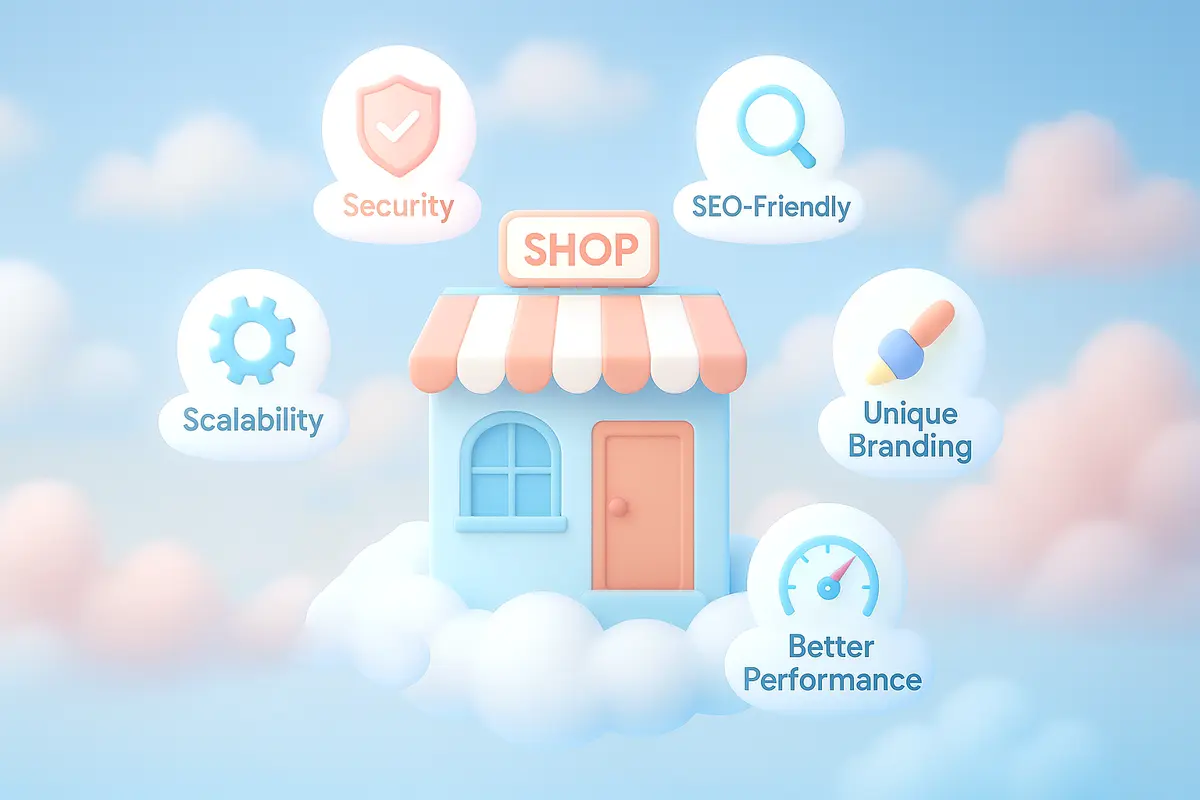
Custom web development helps small businesses build faster, more secure, and scalable websites tailored to their unique goals. Learn the top 5 reasons why going custom beats off-the-shelf solutions.
Top 5 Benefits of Custom Web Development for Small Businesses
Small businesses often struggle to stand out in a competitive online world. With dozens of cookie-cutter templates and plug-and-play builders available, it’s easy to launch a website—but much harder to create one that actually works for your business. That’s where custom web development comes in.
Custom development isn’t just about having a unique design—it’s about building a site tailored to your business goals, your customers’ behaviors, and your long-term vision. In this post, we’ll break down the top 5 benefits of choosing custom web development for your small business, and why it often delivers far better results than going the template route.
1. Tailored to Your Business Goals
Off-the-shelf templates offer convenience but lack precision. They are built to serve the masses—not your unique business model. Whether you’re a boutique consultancy, a local service provider, or an online store, your business needs a digital experience that reflects how you operate and what makes you different.
Custom development allows you to work with a team that takes time to understand your workflows, goals, and customer journeys. The result is a site that feels intuitive to your audience and aligns directly with your business objectives.
For example:
If you’re a fitness studio offering class-based scheduling, your booking system needs to prioritize ease of use and integrations with calendar apps. A generic template won’t cut it. Custom development ensures every interaction is optimized—from how classes are displayed to how confirmations are handled.
This tailored approach also enables smarter lead generation. Whether you want to collect emails, book consultations, or drive product trials, your site is built to move users toward that goal, not just look pretty on launch day.
2. Faster Load Times and Better Performance
Page speed has a direct impact on user behavior and search engine rankings. A slow website means more bounces, fewer conversions, and poor visibility on Google.
Template-based websites often carry a lot of unnecessary baggage—extra CSS, JavaScript from unused features, or third-party libraries included by default. These assets slow down your site, especially on mobile.
Custom development, on the other hand, starts with a clean slate. Developers write code with performance in mind, optimizing for load time, interactivity, and visual stability. Only the features you need are included—nothing more, nothing less.
Tools like Lighthouse, PageSpeed Insights, and GTmetrix help you benchmark performance metrics. With custom dev, it’s easier to meet (or exceed) Core Web Vitals benchmarks—something that’s increasingly important for both SEO and UX.
Real-world impact:
Even a 1-second delay in load time can lead to a 7% drop in conversions. If your website is a revenue driver, this difference alone can significantly affect your bottom line.
3. Scalable and Flexible as You Grow
Your business is constantly evolving—your website should be able to keep up.
One of the biggest downsides of templated platforms is rigidity. Adding new features, redesigning sections, or integrating third-party systems can be tricky, especially if the template doesn’t support customization. This forces many businesses into costly redesigns or platform migrations within 12–18 months of launching.
Custom websites, however, are built to grow with you. You’re working with a codebase that’s modular and adaptable. Need to introduce a new service? Add e-commerce? Launch a customer dashboard? Your dev team can expand the functionality without tearing everything down.
Scalability examples:
- An accounting firm expanding into training can add a learning management system (LMS)
- A product-based business adding affiliate/referral features
- A growing brand shifting from brochure site to a gated member portal
By investing in flexibility upfront, you reduce long-term tech debt and retain control over your growth roadmap.
4. Improved Security and Data Protection
Security is often overlooked by small businesses—until it becomes a problem. Off-the-shelf platforms often rely heavily on third-party plugins or themes, many of which may not be actively maintained. Each plugin is a potential vulnerability.
Custom websites reduce your risk exposure by eliminating unnecessary dependencies and giving your developers full visibility into every part of the code. You control who can access your database, how forms are validated, and what protocols are used to handle user data.
If you process sensitive data— whether it’s customer information, payment details, or user logins—this becomes even more important.
Security best practices in custom builds include:
- Input validation and sanitization
- HTTPS encryption
- Role-based access controls
- Secure APIs and token-based authentication
- Regular server-side patching and monitoring
Beyond just protection, a secure site builds trust. Visitors are more likely to fill out a form or complete a purchase when they feel safe doing so. For industries like healthcare, finance, and legal, this is absolutely critical.
5. Stronger Brand Identity and UX
Your brand isn’t just your logo—it’s how you make people feel when they interact with you. A custom website lets you design an experience that reinforces your identity at every step.
From visual design and typography to microinteractions and copy tone, every part of a custom website can reflect your values and personality. It feels cohesive and intentional—not like it came out of a box.
Think about the difference between these two experiences:
- A templated site that shows generic headings and a stock photo of a business handshake
- A custom site that opens with a strong brand statement, animated elements, and real customer stories
Which one leaves a better impression?
Custom UX design also allows you to create unique flows for your audience. If your target market includes older users, your site can prioritize large fonts and simplified navigation. If you’re targeting Gen Z, interactive layouts and embedded content may resonate more.
Bottom line: good design builds trust. And trust builds conversions.
Final Thoughts
Custom web development isn’t just for big companies with big budgets. For small businesses that want to grow, stand out, and provide a great digital experience, it’s a smart investment that pays off over time.
From performance to flexibility, security to brand identity—a custom site gives you the control, clarity, and confidence to grow online.
Curious what a custom site could look like for your business? Let’s talk.