 19 Sept 25
The exact 30-minute audit sequence we run on real client pages: six lenses, a timer, and no tools you don't already have. Find your biggest conversion leaks before spending another rupee on ads.
We audit landing pages nearly every day at Identiti. It’s practically a production line here. And after enough of them, a pattern becomes impossible to ignore: most pages don’t fail mysteriously. They fail identically. The same six or seven leaks, in slightly different clothes, on page after page after page.
Which is good news for you, because it means you don’t need an agency (or a ₹2 lakh research project) to find your leaks. You need 30 minutes, a timer, and the discipline to look at your own page the way a stranger does.
Here’s the exact sequence we use. Set a timer for each block. The constraint is the method: given unlimited time you’ll rationalise, given five minutes you’ll see.
Minutes 0–5: The Five-Second Stranger Test
Open your landing page in an incognito window on your phone. Look at only what’s visible before any scrolling, for five seconds. Close it. Now answer, out loud:
- What does this company offer?
- Who is it for?
- What am I supposed to do next?
If you fumbled any of the three, and you built the page, a cold visitor from an ad has no chance. This is still the most common failure we log: heroes that describe a philosophy (“Empowering growth through innovation”) instead of an offer.
Better yet, don’t answer it yourself. Forward the link to someone who’s never seen it and ask them the three questions. Their confusion is data.
Minutes 5–15: The LIFT Walkthrough
Now scroll the full page slowly, scoring it against the six factors of the LIFT Model, the conversion framework we use in real audits. Rate each 1 to 5, honestly:
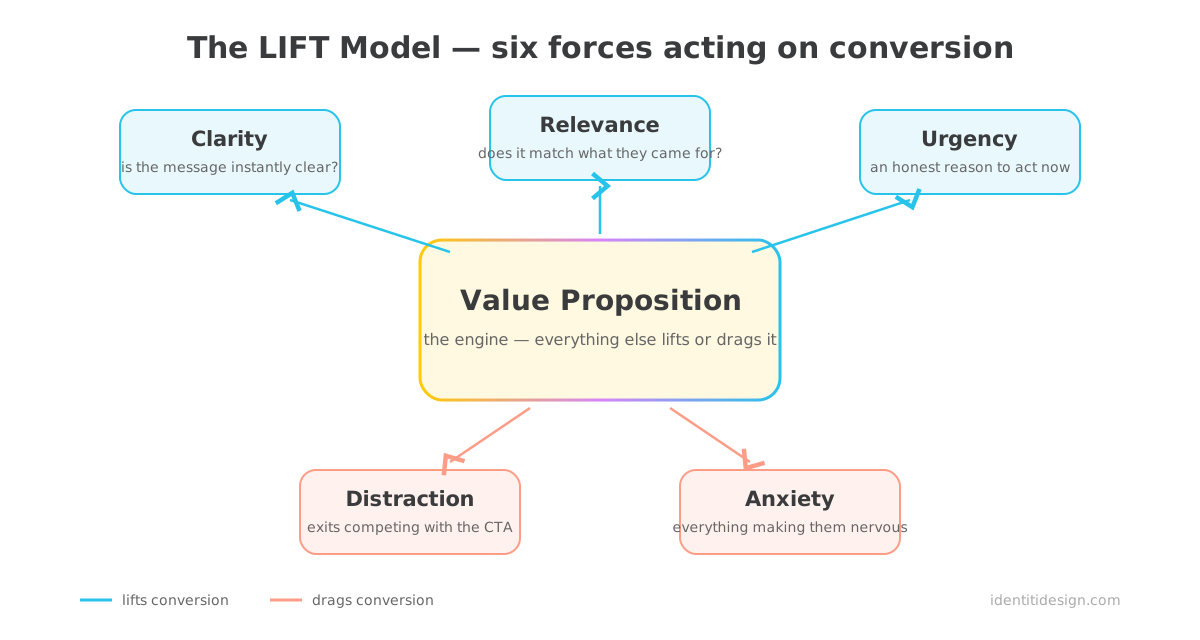
Value proposition. Is the specific value stated, or implied? “SaaS websites that convert” beats “digital excellence.” Numbers beat adjectives.
Clarity. Could a distracted person skim only the headlines and still get the pitch? Read just your H1s and H2s top to bottom. Do they tell the story alone?
Relevance. Does the page continue the conversation the visitor started? If your ad says “marketing automation” and the page opens with your founding story, you’ve broken the thread. We’ve written about this failure at length in why websites don’t generate leads.
Distraction. Count the links above the fold that are not your primary CTA. Every one is an exit ramp. Great landing pages are almost claustrophobic: one goal, everywhere.
Urgency. Is there any honest reason to act now rather than someday? (Fake countdown timers don’t count, and smart visitors know.)
Anxiety. What’s making people nervous? Vague pricing, no faces, no proof, a 14-field form asking for a phone number before saying hello. List every anxiety trigger; you’ll fix them cheapest of all.
Your three lowest scores are your test roadmap. Done. That’s the strategy half.
Minutes 15–20: The Speed Reality Check
Run the page through PageSpeed Insights. Ignore the desktop score; look at mobile, and look at field data if you have it. Two numbers matter most: LCP (how long until the main content is visible; under 2.5s or you’re bleeding) and CLS (does the page jump around while loading).
We’ve watched beautifully argued pages lose to ugly fast ones purely on this. Persuasion can’t start until the page exists.
Minutes 20–25: The Thumb Test
Back to your phone. This time interact:
- Can every button be hit with a thumb, first try?
- Does the form open the right keyboard (numeric for phone, email for email)?
- Does anything overlap, clip, or require pinch-zoom?
- Is the CTA reachable without scrolling past a wall of text?
For most of our clients, 60 to 75 percent of paid traffic is mobile. Auditing on desktop is auditing the minority experience.
Minutes 25–30: Follow Your Own Form
Actually submit your own form, start to finish. Count the fields. Every field past four costs you completions, and most pages ask for data nobody will ever use. Then look at what happens after submission: a dead-end “thanks!” page, or a next step that keeps momentum? Then check: did the lead arrive where it should (CRM, inbox, Slack)? Did your analytics record a conversion?
You’d be startled how many businesses running paid traffic fail that last check silently. It’s the first thing we verify in professional audits, because a broken conversion pixel makes every other number a lie.
What To Do With Your Findings
You now have a scored list of leaks. Resist redesigning everything. Fix in this order:
- Broken things (tracking, forms, mobile bugs): today
- Clarity of the hero: this week
- Your lowest LIFT score: as your first A/B test
- Everything else: one change at a time, measured
One honest caveat. A 30-minute heuristic audit finds the probable leaks; confirming them takes data (session recordings, analytics, real user tests). But in our experience, this half-hour surfaces about 70 percent of what a full professional audit finds, and 100 percent of the embarrassing stuff.
And if you run the timer and want a second pair of eyes, a deeper audit with the data half included is exactly what we do.