 5 Dec 25
The hero section decides whether most visitors stay or leave. Here are eight proven structures for that first screen, what each one does well, and when to reach for it.
The hero section, that first screen a visitor sees before scrolling, does more conversion work than the rest of the page combined. Most people decide whether to stay or leave based on what they catch in the first few seconds, and that is almost entirely the hero. Get it right and the rest of the page gets a chance to work. Get it wrong and your best content below the fold is read by nobody. The good news is that great heroes are not magic, they follow a handful of proven structures. Here are eight formulas that consistently convert, what each does well, and when to use it.
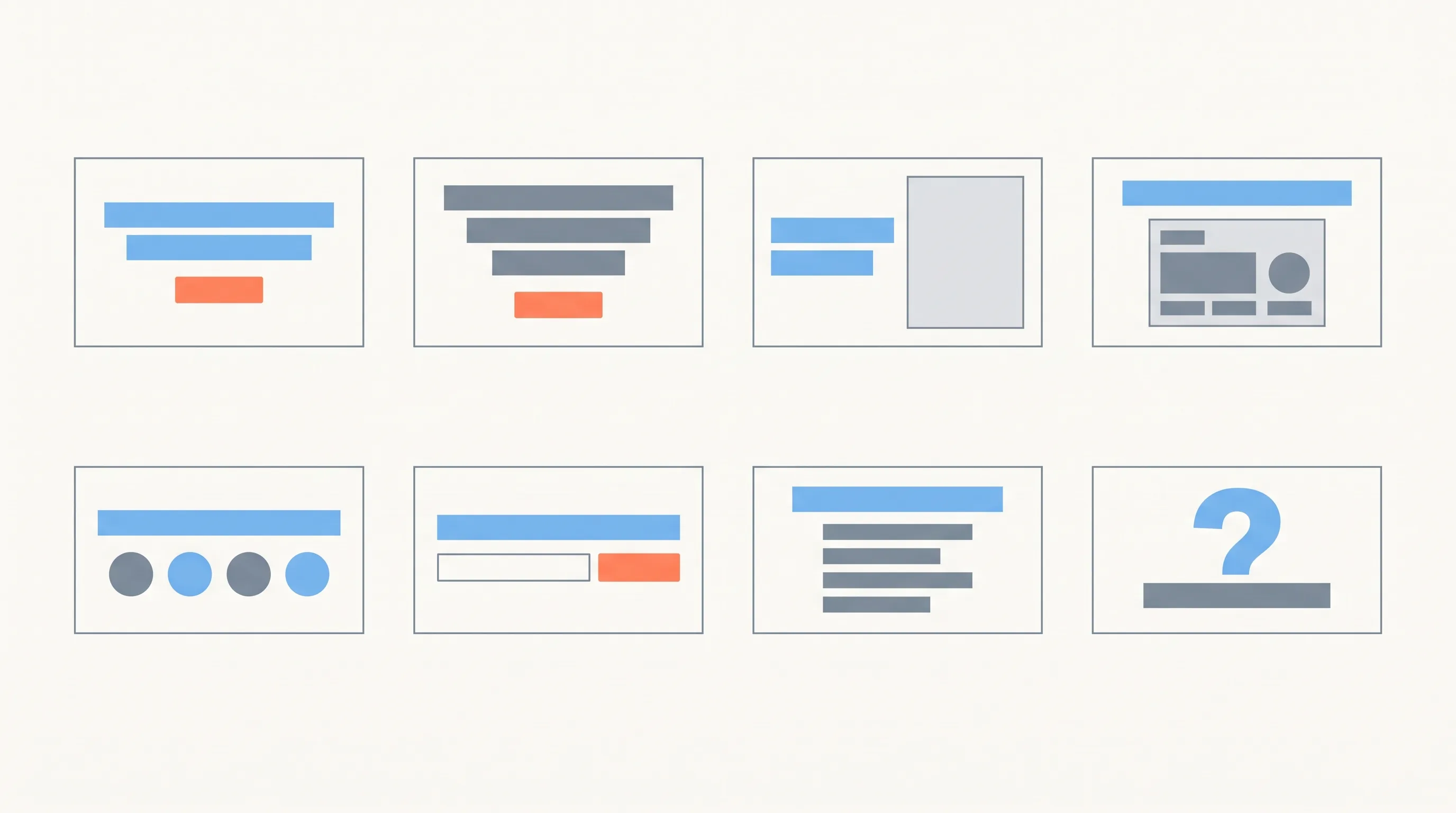
The Formulas
✅ 1. The Clear Value Proposition
The workhorse and the one to master first: a sharp headline stating exactly what you do and who it is for, a short supporting line, and one clear call to action. No cleverness, no mystery, just an unmissable statement of the value on offer. It works because clarity beats cleverness almost every time in that first second, and a visitor who instantly understands what you offer is far more likely to stay than one puzzling out a witty headline. If you only ever nail one hero formula, nail this one, because it is the foundation the others build on and the single clear message a skimmer must catch.
✅ 2. The Problem-Agitate-Solution
Open by naming the visitor’s problem, briefly sharpen why it hurts, then present yourself as the solution. This formula works when your audience feels a real pain acutely, because leading with their problem creates instant recognition, a “yes, that is exactly my situation” that pulls them in before you have said anything about yourself. The risk is overdoing the agitation and coming across as manipulative, so keep the middle beat light. Used with restraint, it is powerful for pain-driven purchases where the visitor already knows something hurts and is hunting for relief.
✅ 3. The Outcome-Led Hero
Lead not with what your product is but with the result the visitor gets from it. Instead of “project management software,” something like “ship projects on time, every time.” This works because people buy outcomes, not features, and a hero that paints the after-state speaks directly to what they actually want. It is especially strong when your outcome is more compelling than your category, which is often, because categories are boring and outcomes are the reason anyone showed up. Show them the destination, not the vehicle.
✅ 4. The Product-in-Action Hero
Pair a tight headline with a real visual of the product doing its thing, a screenshot, a short loop, an interface shot. This formula converts when seeing the product is more persuasive than describing it, which is common for visual or interface-heavy products where a picture does what a paragraph cannot. It also builds instant credibility, because showing the real thing signals you have nothing to hide. The product screenshot often carries the hero better than any adjective, so if your product looks good in action, let it.
✅ 5. The Social Proof Hero
Put credibility right at the top: a headline supported immediately by a strong proof point, a recognisable logo strip, a striking number, a standout testimonial in the hero itself. This works when trust is the main barrier to conversion, because it answers the visitor’s instinctive skepticism before they have finished forming it. It is particularly effective for higher-consideration purchases and for brands the visitor does not yet know, where “why should I believe you?” is the first silent question. Lead with proof and you disarm the doubt early.
✅ 6. The Headline-Plus-Form Hero
For lead generation, put the form directly in the hero rather than making people scroll or click to find it. A clear value proposition beside a short, inviting form removes a step between interest and action, and removing steps lifts conversion. This works best when the offer is strong enough to earn the ask immediately and the form is short enough not to intimidate, so pair it with the restraint that keeps a form from scaring people off. When the visitor is ready and the form is easy, putting it right there captures intent at its peak.
✅ 7. The Specificity Hero
Win trust through concrete detail instead of broad claims. Rather than “we help businesses grow,” something precise: a specific audience, a specific result, a specific mechanism. This converts because specificity is inherently more believable than generality, and a visitor who sees a hero that seems to describe their exact situation feels understood in a way a vague promise never achieves. It works especially well for niche or specialised offers, where being narrowly, precisely right for a particular visitor beats being loosely appealing to everyone. Specific and true beats broad and forgettable.
✅ 8. The Question Hero
Open with a question that names the visitor’s exact situation, so their own “yes” pulls them into the page. Done well, it creates immediate engagement and self-selection: the right visitor answers yes in their head and reads on, the wrong one filters themselves out, which is fine. The danger is a lazy or obvious question that feels like a gimmick, so the question has to be genuinely resonant, the kind that makes the right person feel seen. When it lands, it is one of the most engaging openings there is, because a question the visitor is already asking themselves is irresistible.
How to Choose and Use These
Do not pick a formula by taste, pick it by your situation. If your main barrier is confusion, lead with clarity or specificity. If it is disbelief, lead with social proof. If it is a felt pain, lead with problem-agitate-solution. If your product sells itself visually, show it in action. The formulas are tools, and the skill is matching the tool to the specific barrier standing between your visitor and conversion, the same diagnostic thinking behind every good landing page teardown.
You can also combine them, an outcome-led headline with social proof beneath, a clear value proposition with the form right there, because the formulas are not mutually exclusive. But whatever you choose, test it, because your specific audience is the final judge of what works on your specific page. Start from the formula that fits your biggest barrier, make it clear and strong, and then let real visitors tell you whether you chose right. The hero is too important to guess at twice.
If you want a hero section built to convert your specific audience, that is exactly the kind of work we do.