 14 Nov 25
Every step in your signup flow costs you users, but sales still wants the data. Here is how to shorten a signup flow, cut the drop-off, and keep the information that matters, without choosing one over the other.
The signup flow is where a huge amount of hard-won intent leaks away, and it is caused by a tug of war that almost every SaaS loses. Marketing wants the flow short, because every step costs users. Sales wants the flow long, because they want the data: company size, role, phone number, use case. The compromise is usually a bloated flow that satisfies sales and quietly bleeds conversions, and nobody connects the soft signup numbers to the seven fields sales insisted on. You do not have to choose between a short flow and rich data. You have to sequence them differently.
Here is how to reduce signup steps without losing the information that matters.
First Principle: Every Step Is a Chance to Leave
Start by internalising the cost. Each field and each step in a signup flow is a small decision point where some fraction of people abandon. This is not a marginal effect; it is one of the most consistent findings in conversion work. A flow with ten fields does not convert slightly worse than a flow with three, it converts dramatically worse, because friction compounds. So the default posture should be ruthless: every field is guilty until proven necessary, and “sales would like to know” is not proof. The bar is whether the very next step genuinely requires it.
Separate “Need Now” From “Want Eventually”
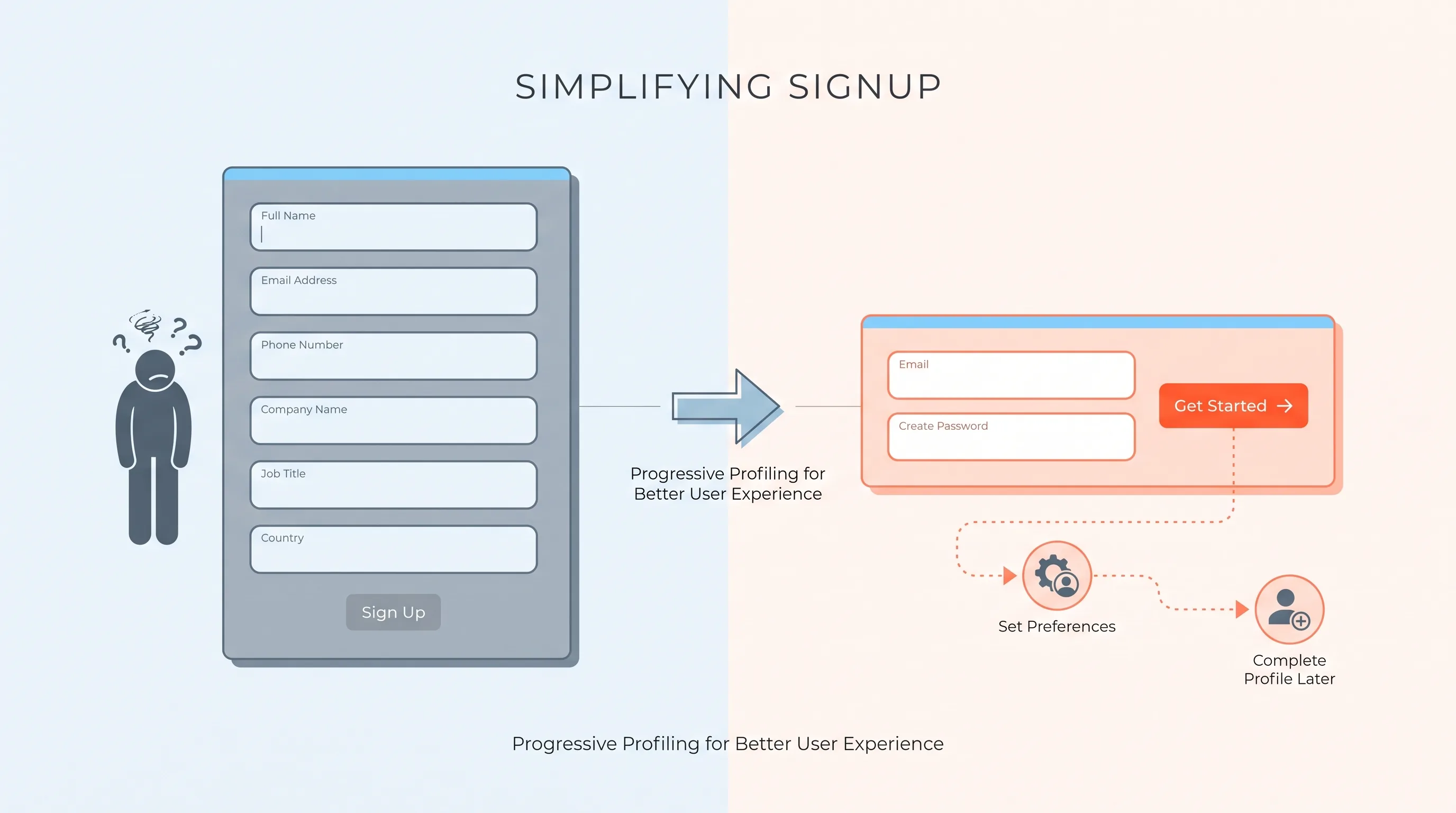
The core move is to split your data requirements into two piles. There is what you genuinely need to create the account and get the person to value, which is usually almost nothing: often just an email, sometimes not even a password upfront. And there is everything else you would like to know, which is real but not urgent. The mistake is collecting both at signup. The fix is collecting the first pile at signup and the second pile later, once the person is already a user with a reason to keep engaging.
This reframes the whole problem. You are not deciding whether to collect the data. You are deciding when. And “later, when they are already in” almost always beats “now, at the fragile moment before they have committed.”
Progressive Profiling: Get the Data After the Yes
The technique that makes this work is progressive profiling: gathering information gradually, across the early experience, instead of all at once at the gate. Ask for the company name when they set up their workspace, because that is the natural moment for it. Ask for the role when it actually changes what they see. Ask for the phone number when they request something that warrants a call. Each piece of data is collected at the point where it makes sense to the user and where the friction is lowest, which is after they are already committed rather than before.
The data sales wanted still arrives. It just arrives from people who are now users instead of being extracted from strangers at the exact moment most likely to scare them off. And because you can enrich a lot of it in the background from a business email, you often need to ask for far less than you think. This is the same discipline that keeps a form converting: ask only for what the next step needs, and defer the rest.
Reduce Steps, Not Just Fields
Fields are half of it; steps are the other half. A flow spread across four screens feels longer than the same fields on one, and every screen transition is a chance to lose someone. Where you can, collapse the flow: fewer screens, a visible sense of how short it is, and no surprise steps appearing after the person thought they were done. If a multi-step flow is genuinely necessary, show progress honestly so people know how close they are to finished, because uncertainty about how much is left is its own kind of friction.
And question the steps that are not data at all. The forced email verification before someone can even look around, the mandatory tour, the “invite your team” wall before they have seen any value: each of these is a step that costs users for the company’s convenience, not the user’s. Move them after the first moment of value, not before it.
Do Not Break the Handoff
One warning as you streamline: the signup flow is also where lead data is captured and routed, so shortening it must not quietly break the plumbing. As you cut fields and steps, confirm that the lead still lands in your CRM with its source attached, that routing and scoring still fire, and that a shorter flow has not orphaned the tracking. A signup flow that converts beautifully but drops the source data has traded one problem for another. Test the whole path end to end after every change.
A Word on Social and Single-Sign-On
One more lever worth naming: the fastest field to remove is the one a login provider fills for you. Offering signup with an existing account the user already has removes the password step, often the email step, and the friction of creating yet another credential. It is not right for every product, and it comes with its own trade-offs around data and account management, but for many SaaS signups it is the single biggest step-reduction available, because it replaces a form with a click. Weigh it against how much you genuinely need a separate credential, and where it fits, it collapses the flow further than any amount of field-trimming can.
The Payoff
Signup flow CRO is one of the highest-leverage projects in SaaS because it sits directly on top of activation, and activation sits directly on top of revenue. Shorten the flow to what the next step truly needs, defer the rest to moments when the user is already engaged, collapse unnecessary steps, and protect the data plumbing, and you get more users through the door without giving up the information the business runs on. It is the rare optimisation where marketing and sales both win, once they stop fighting over the wrong question. The same instinct sits behind why some pages convert visitors but not trials: the leak is almost always more friction than the page needed.
If you want your signup flow audited and streamlined without losing the data you rely on, that is exactly the kind of work we take on.