 10 Nov 25
Between a signup and a paying, renewing customer lies a series of moments where people quietly fall away. Here is the full funnel mapped, with the automated touchpoint that should catch people at each stage.
Most SaaS teams can tell you their signup number and their revenue number. Far fewer can tell you what happens in between, which is strange, because the entire business lives in that gap. A signup is not a customer. It is a person who has raised their hand and now has to be carried, through a series of quiet moments where people fall away, all the way to paying and then to renewing. Every one of those moments is a place where an automated touchpoint should be doing the carrying, and where its absence is a leak.
Here is the full funnel mapped, stage by stage, with the touchpoint that belongs at each. Think of it as a checklist for where your automation should exist, so you can find the stages where it does not.
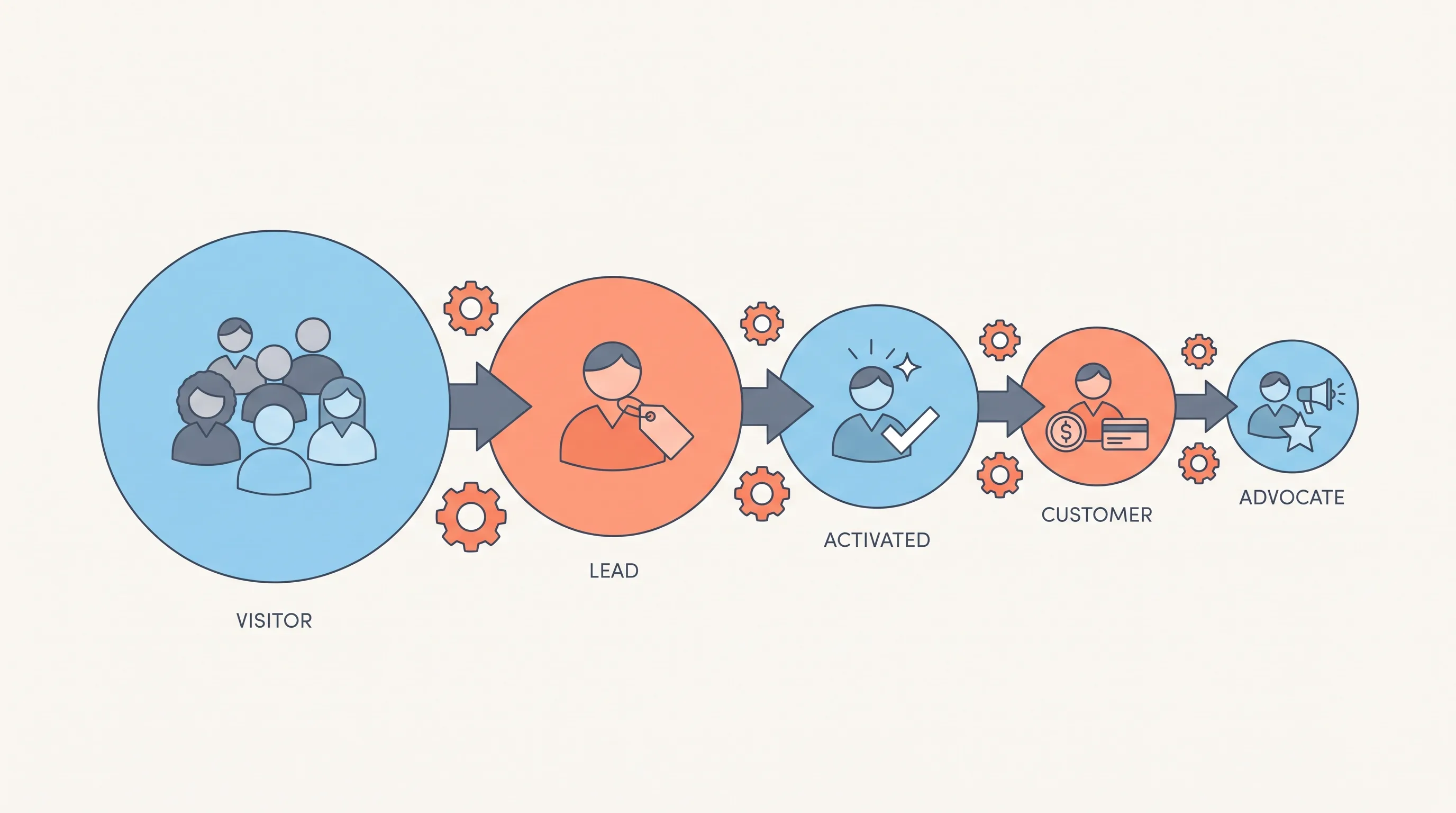
Stage 1: Visitor to Lead
The first gap is between someone landing and someone identifying themselves. The touchpoint here is capture done properly: a form that asks only what the next step needs, an instant response so the moment of intent is never met with silence, and, critically, the source captured so you know where this lead came from. Most funnels leak at the very top simply because the capture is clumsy or the response is slow, which is why a lead routing workflow that never sleeps sits right at the mouth of the funnel.
Stage 2: Lead to Activated User
A signup that never uses the product is not a lead, it is a statistic. The touchpoint between signing up and actually getting value is the most important one in the whole funnel, and the most neglected. It is a welcome sequence that points at the single first action that predicts retention, followed by behaviour-based nudges that respond to whether the person actually took it. Same moment, different message depending on what they did, which is the entire logic of a trial onboarding sequence that converts. Get people to their first win, or watch them evaporate.
Stage 3: Activated User to Paying Customer
Now the money moment. A user who has felt the value still has to decide to pay, and doubt creeps in right before they do. The touchpoints here are proof timed to that doubt, a customer story from someone like them, and a clean, respectful trial-ending sequence that reminds them of the specific value they already got and makes continuing easy. Urgency without value is just pressure; value plus a clear decision converts the people who were always going to be good customers.
Stage 4: Paying Customer to Retained Customer
The funnel does not end at the first payment, and treating it like it does is how SaaS businesses leak revenue out the back while pouring it in the front. A new customer needs an onboarding touchpoint that gets them to their next milestone, turning a purchase into a habit. And existing customers need a watching touchpoint: an automation that notices the signals of drifting away, going quiet, usage falling, a payment failing, and triggers a save before they are gone. Winning back an at-risk customer is far cheaper than replacing a lost one, but only if something is watching for the signal.
Stage 5: Retained Customer to Advocate
The final stage is the one almost nobody automates, and it compounds the hardest. A happy, retained customer is a source of referrals, reviews, and word of mouth, but only if you ask, at the right moment, in the right way. A touchpoint that recognises when a customer has hit a success milestone and gently invites them to share it turns your best customers into a growth channel. This is the stage that quietly lowers the cost of every stage above it.
Why Mapping It Matters More Than Any Single Fix
Here is the real value of laying the funnel out like this. Most teams do not have a touchpoint problem, they have a blind-spot problem. They have decent automation at one or two stages and nothing at the others, and they cannot see the gap because they never mapped the whole path. When you draw the full funnel and put a name to the touchpoint each stage needs, the leaks become obvious: “we have great onboarding but nothing catches at-risk customers,” or “we capture leads well but never nurture the ones who are not ready.” The map turns a vague sense that “our funnel could be better” into a specific list of missing pieces.
This is why we start engagements by mapping the funnel before touching any single automation. A brilliant welcome sequence cannot save a funnel that has no retention touchpoint, and the only way to see that is to look at the whole thing at once. It is the same reason a business runs a full set of automations rather than one heroic sequence: the funnel is a chain, and a chain is only as strong as its emptiest link.
Where to Start If Your Funnel Feels Empty
If you map your funnel and find touchpoints missing at most stages, do not try to build all of them at once. Work in order of money-proximity. The stages closest to revenue get fixed first: capture and routing at the top, because a lead that never lands is the most expensive leak of all, and the trial-to-paid touchpoints in the middle, because that is where intent turns into income. Retention and advocacy matter enormously and compound over time, but they can come once the front and middle of the funnel are holding, because there is little point saving customers you were never converting in the first place.
The goal is not a perfect funnel overnight. It is a funnel with no empty stage, built in the order that protects revenue first. Map it once, honestly, find the emptiest link, fill it, and move to the next. Do that a few times and the leaks that were quietly draining the business close one by one, which is how a funnel goes from a vague worry to a system you can actually trust.
If you want your signup-to-revenue funnel mapped and the missing touchpoints built, that is exactly where we begin.