 19 Oct 25
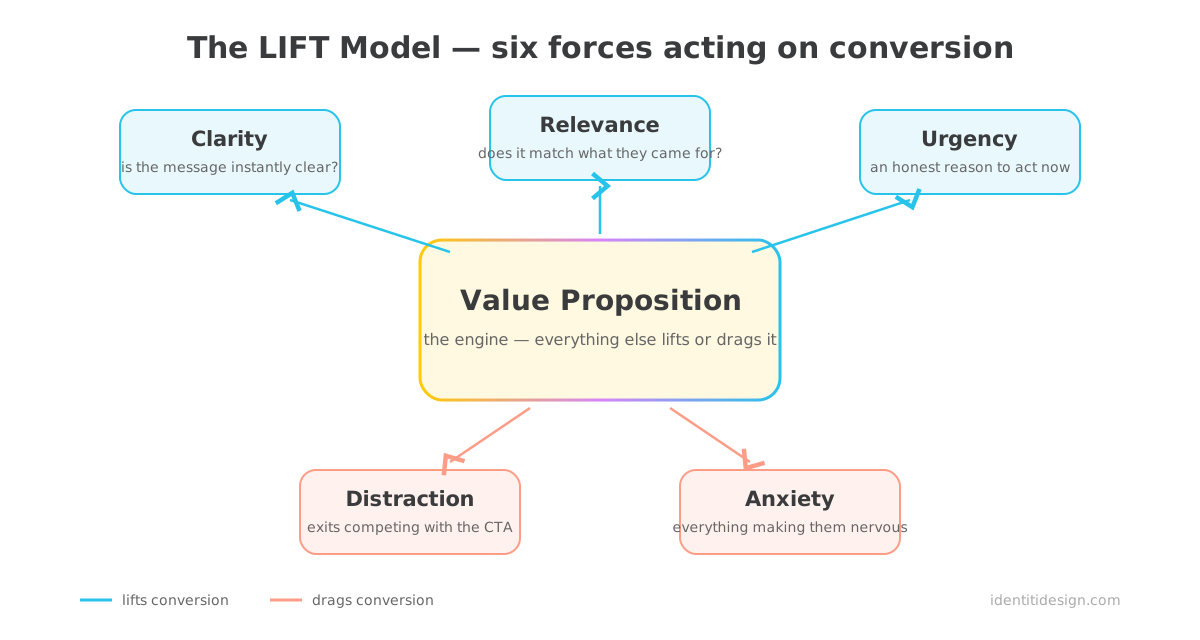
A practical walkthrough of the LIFT Model, the framework we use to diagnose why a page converts or does not: value proposition at the centre, three forces that lift it, and two that drag it down.
When a page underperforms, most teams reach for opinions. “The button should be green.” “The headline is boring.” “Let us add a video.” Opinions are cheap, they multiply, and they contradict each other, which is why redesigns driven by opinion so often move the number in the wrong direction. What you want instead is a shared lens: a way to look at any page and name, specifically, what is helping conversion and what is fighting it.
The LIFT Model is that lens, and it is the one we reach for first on almost every audit. It was developed by Chris Goward at WiderFunnel, and its genius is that it turns a vague “this page feels off” into a structured diagnosis. Here is how it works, and how to actually use it.
The Plane and the Forces
Picture your value proposition as an aeroplane trying to take off. That plane is the thing you are actually offering: the outcome, the value, the reason to care. Everything else on the page is a force acting on it. Three forces give it lift. Two create drag. Conversion is simply what happens when lift beats drag.
This is the first useful idea in the model: your conversion rate is not one thing you optimise, it is the net result of five forces pushing in different directions on one core offer. Fix the wrong force and nothing moves. Name the right one and the page climbs.
The Engine: Value Proposition
Before the five forces, the plane itself has to be worth flying. If the underlying offer is weak, no amount of clarity or urgency will save it. The value proposition is the perceived benefit minus the perceived cost, and it is the single biggest lever on the page. Everything below assumes the offer is genuinely good and the problem is that the page is failing to present it well. If the offer itself is the problem, that is a positioning conversation, not a CRO one.
The Three Forces That Lift
Clarity
Clarity is how quickly and completely a visitor understands your value proposition and how to act on it. It is almost always the highest-impact factor, and almost always the most underrated. A real example: a B2B SaaS homepage that opened with “Orchestrate your revenue operations.” Nobody outside the company knew what that meant. Rewritten to “See every deal, forecast, and rep in one place,” the same page suddenly explained itself. No new feature, no redesign, just clarity restored. When we run a 30-minute self-audit, clarity is the first thing we grade, because it gates everything else.
Relevance
Relevance is the match between what the visitor expected and what the page delivers. It is where paid traffic quietly bleeds: the ad promises one thing, the page talks about another, and the disconnect at the moment of arrival reads as “wrong place.” A landing page that continues the exact sentence the ad started, in the same words, is high on relevance. A generic homepage catching a specific ad click is low on it. This is why we are so insistent that ads deserve a dedicated page built to match their promise.
Urgency
Urgency is the presence of an honest reason to act now rather than later. Note the word honest. Fake countdown timers and “only 2 left!” on infinite digital goods do not build urgency, they build distrust, which is a drag force. Real urgency comes from genuine scarcity, a deadline that actually exists, or simply making the cost of inaction vivid: what the visitor keeps losing every week they do not solve this. Of the three lift forces, urgency is the one to add last and most carefully.
The Two Forces That Drag
Anxiety
Anxiety is every doubt, fear, and hesitation the page creates or fails to resolve. Is my data safe? What happens after I click? Will this be hard to cancel? Is this priced for a company my size? Each unanswered anxiety is a small hand pulling the visitor back from the button. The fix is not to hide the scary things, it is to answer them exactly where they arise: the security note by the data field, the “no card required” by the trial button, the cancellation policy near the commitment. Broken or invisible proof is a major source of anxiety, which is one reason tracking and trust signals sit so high on our checklist.
Distraction
Distraction is everything on the page competing with the one action you want. Navigation bars, secondary links, autoplaying carousels, five different calls to action, a chat bubble that covers the CTA on mobile. Each one is an invitation to do something other than convert. The single most common high-impact fix we make on landing pages is subtraction: strip the page down to its one job and watch conversion rise, because you have removed the exits. This is doubly important on low-traffic sites where you cannot A/B test your way out and have to reason from principle instead.
How to Actually Use It
Do not just read the model, run your page through it. Take your most important page and score each of the five forces honestly from one to five. Where is the lowest score? That is your first project, not the thing your loudest stakeholder wants to change. Usually it is clarity or distraction, because those are the cheapest to fix and the most commonly broken.
The reason we trust this lens over opinion is that it makes disagreements productive. “I think the button should be blue” is unfalsifiable. “This page is low on clarity because a first-time visitor cannot tell what we do in five seconds” is a diagnosis you can test, fix, and verify. It turns CRO from redecorating into diagnosis, which is the whole difference between conversion work that compounds and conversion work that just churns the page.
If you want your key pages scored against the LIFT Model by people who use it every week, that is exactly how we open most engagements.