 27 Nov 25
An audit gives you a pile of problems. A roadmap turns that pile into an ordered plan of what to fix and test first. Here is how to prioritize CRO work so effort goes where the return is highest.
An audit is the easy part. Run a proper conversion audit and you end up with a long list of problems: the headline is vague, the form is too long, the proof is weak, the page is slow, the mobile experience is rough. That list feels like progress, and then it becomes the problem, because a pile of twenty issues with no order is paralysing. Teams either freeze, unsure where to start, or worse, start with whatever is easiest or whatever the loudest person cares about. A CRO roadmap is what turns the pile into a plan. Here is how to build one that puts effort where the return actually is.
The Roadmap Is About Order, Not Just Action
The whole value of a roadmap is sequence. You cannot fix everything at once, and even if you could, you would learn nothing, because when ten changes ship together and the number moves, you cannot tell which change did it. So a roadmap is a deliberate order: what to do first, second, third, chosen so that the highest-return work happens soonest and each change teaches you something. Without that order, CRO becomes a scatter of random fixes, and a scatter rarely compounds.
Score Every Finding on Impact and Effort
The core tool is embarrassingly simple and genuinely powerful: score each finding on two axes, how much it could move conversion (impact) and how hard it is to do (effort). Those two numbers sort your entire list into four groups, and the groups tell you exactly what to do.
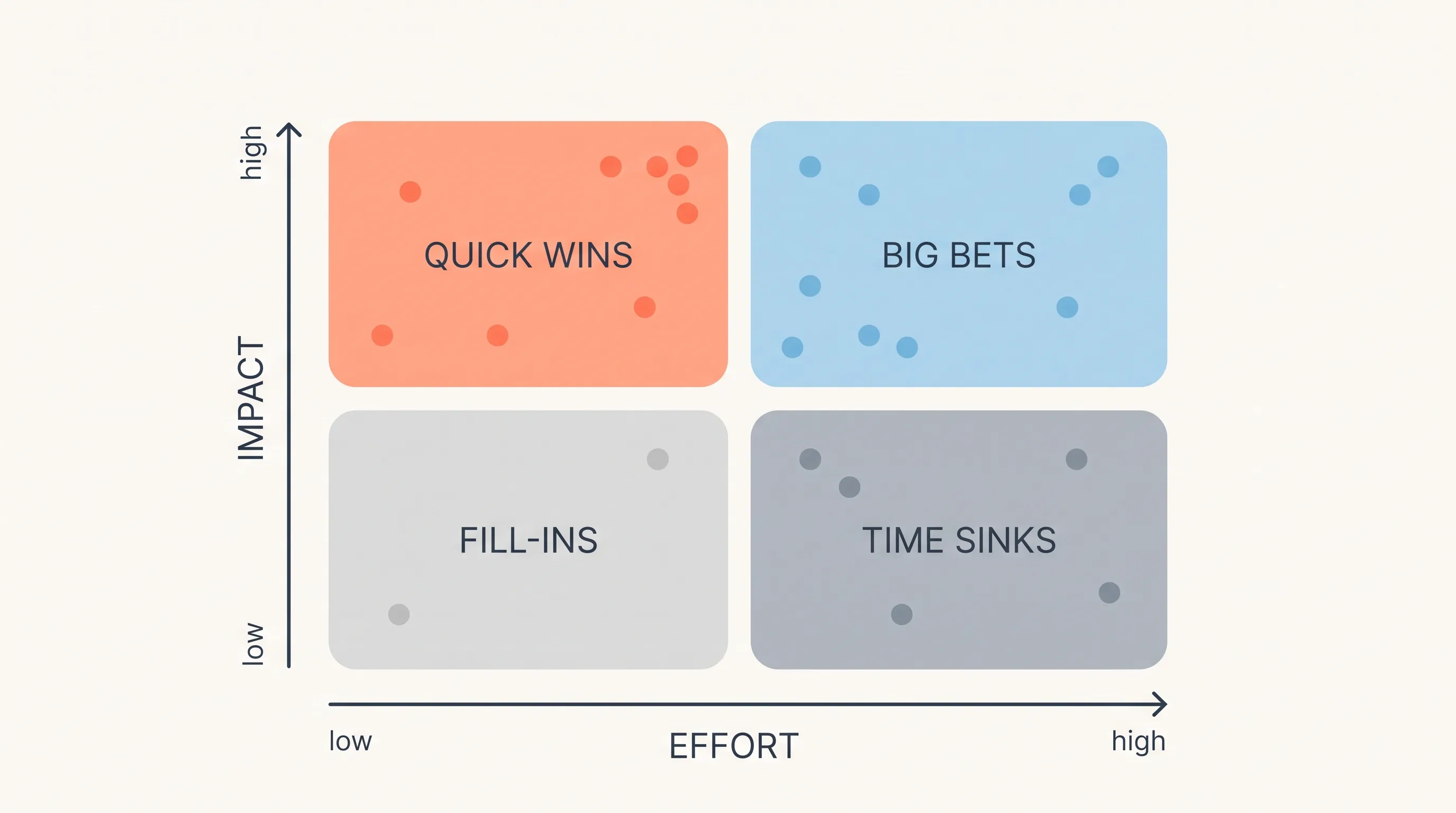
High impact, low effort: do these first. These are the quick wins, the changes that move the number a lot for little cost, like fixing a broken headline or removing an unnecessary form field. They are the entire reason to prioritise, because they front-load your return. Start here, always.
High impact, high effort: plan these deliberately. The big bets, a full page redesign, a new signup flow, worth doing but worth planning properly rather than rushing. Schedule them once the quick wins are banked and you have earned the momentum and the credibility.
Low impact, low effort: fill-ins. Fine to do when you have spare capacity, but never at the expense of the quick wins. These are the trap that busy teams fall into, doing easy-but-pointless work because it feels productive.
Low impact, high effort: avoid. The time sinks. Hard work for little return, and yet these get done constantly because someone is attached to them. The roadmap’s quiet superpower is giving you permission to not do these.
Estimate Impact Honestly
The scoring only works if the impact estimates are honest, and this is where judgement and evidence matter. Impact should be informed by how much traffic the fix affects and how central it is to the conversion, not by how much you personally care about it. A tiny tweak on your highest-traffic money page can outrank a dramatic overhaul of a page nobody visits. Lean on a framework like the LIFT model to reason about which findings actually touch the biggest conversion forces, so your impact scores reflect the page’s reality rather than your preferences. Where you have data, use it; where you do not, estimate deliberately and mark it as an estimate.
Sequence for Learning, Not Just Return
One refinement on top of pure impact-versus-effort: order the work so you also learn as you go. Ship changes in a sequence where each one is measurable on its own, so you build up real knowledge of what works on your specific audience, not just a better page. Run the tests so they actually teach you something rather than shipping five fixes blind. Over a few cycles this turns your roadmap from a to-do list into a growing understanding of your customers, which is worth more than any single fix.
Keep It Living
A roadmap is not a document you write once and follow to the letter. Each change you ship gives you new data, which reshuffles the remaining priorities, sometimes promoting a finding you had ranked low or killing one that turned out not to matter. Revisit the roadmap after each cycle: re-score with what you have learned, and let the order evolve. The plan is a living hypothesis about where the return is, updated by evidence, not a fixed contract.
The Mistake That Kills Roadmaps
One failure mode is common enough to name. A team builds a beautiful roadmap, ships the first quick win, sees the number move, and then abandons the roadmap to chase whatever new idea just came up in a meeting. The discipline of a roadmap is not building it, it is following it, and the pull to jump to the shiny new idea is constant. Every time you abandon the sequence to chase an impulse, you lose the compounding that made the roadmap worth building, and you slide back toward the random-scatter approach it was supposed to replace.
The fix is to treat new ideas as roadmap inputs, not roadmap interruptions. When a fresh idea arrives, do not drop everything to do it. Score it on the same impact-and-effort axes as everything else and slot it into the order where it belongs. Sometimes it really is a quick win worth promoting; often it is a low-impact impulse that felt urgent because it was new. The roadmap is precisely the tool that tells the difference, so use it to evaluate the new idea rather than letting the new idea override it. A roadmap you actually follow beats a better roadmap you keep abandoning.
The Payoff
A CRO roadmap is the difference between conversion work that compounds and conversion work that churns. It ensures the highest-return fixes happen first, that effort does not leak into time-sinks, and that each change teaches you something for the next one. The audit finds the problems; the roadmap makes solving them a system instead of a scramble. That system, applied patiently, is how a page gets meaningfully better over time rather than just different.
If you want your audit findings turned into a prioritised roadmap and worked in the right order, that is exactly how we run CRO.