 29 Nov 25
Conversion optimisation is not a project you finish, it is a loop you run. Here is the weekly workflow we use to turn CRO from occasional big pushes into a steady engine that compounds.
Most teams treat conversion optimisation as an event. Every so often, someone notices the numbers are soft, a project gets spun up, a batch of changes ships, and then everyone moves on until the next time it feels bad. This produces occasional bursts of improvement separated by long flat stretches, which is a slow and lumpy way to get better. The teams whose conversion rate climbs steadily are not the ones with bigger bursts. They run CRO as a loop, a small repeating cycle that turns optimisation from an occasional push into a steady engine. Here is the weekly workflow we use.
Why a Loop Beats a Project
A project has an end, and that is exactly its weakness for CRO. Conversion is never solved, only improved, because your audience shifts, your traffic changes, and every fix reveals the next constraint. So a project that finishes leaves you flat until the next one starts, while a loop never stops compounding. The loop also solves the discipline problem: instead of relying on someone noticing the numbers are bad and mustering the energy for a push, the work just happens every week because it is a routine. Small and constant beats big and occasional, because small and constant compounds and big and occasional decays between pushes.
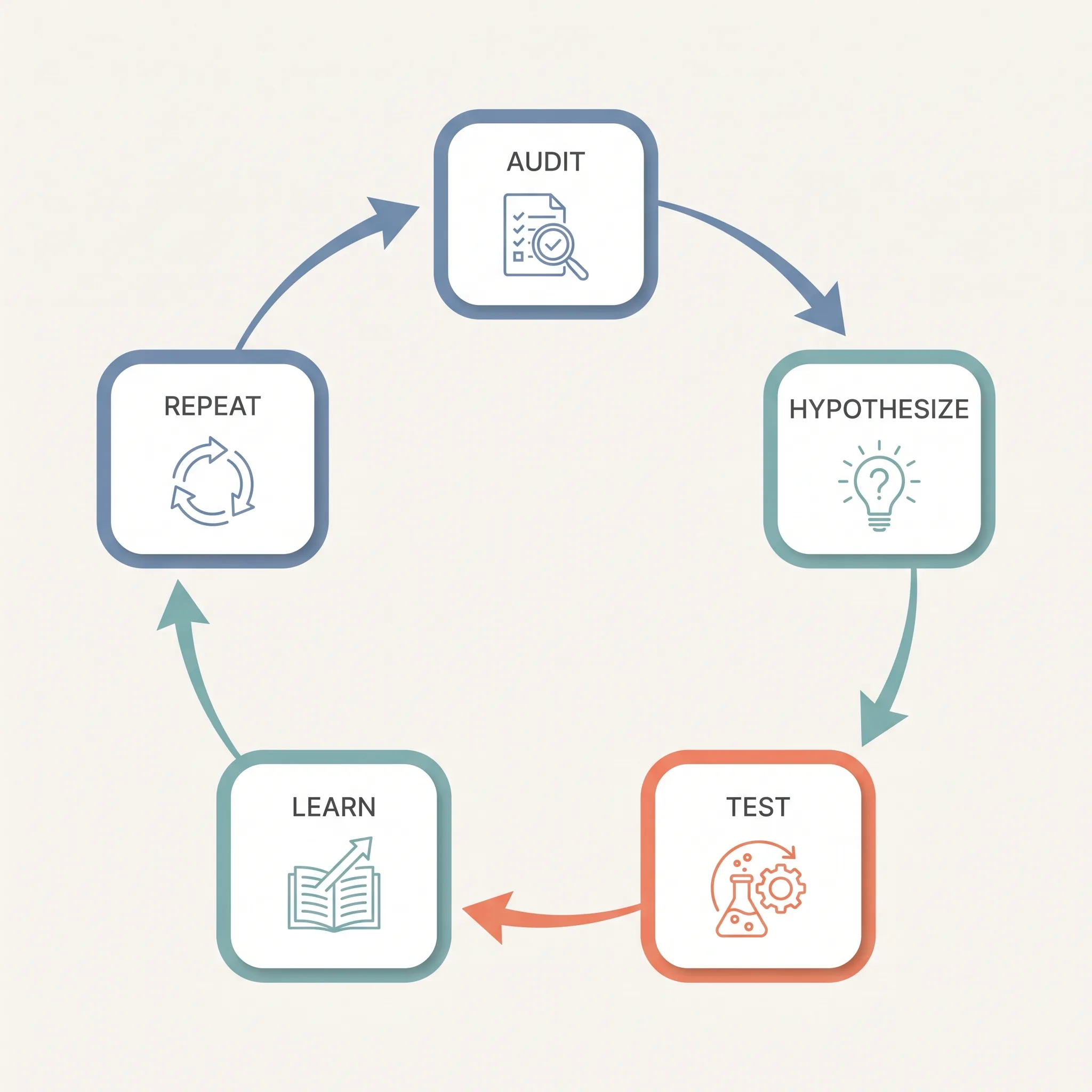
The five stages below are that loop. None is complicated on its own. The power is in running them every week without breaking the chain.
Stage 1: Audit, But Lightly and Continuously
The first stage is looking, but not the heavy one-off audit you run when starting fresh. This is a light, recurring scan: where is conversion leaking this week, what does the data show that it did not last week, which page or step is underperforming its potential. You are not re-auditing everything every week, you are watching the same vital signs and noticing what moved. A full conversion audit is the deep version you run occasionally; the weekly audit is the pulse check that keeps you pointed at the current biggest problem rather than last quarter’s.
The output of this stage is a single thing: the most valuable problem to work on right now. Not a list of twenty, just the one the evidence says matters most this week. Resisting the urge to tackle everything is the whole skill here.
Stage 2: Hypothesize, So the Test Means Something
Once you have the problem, you form a hypothesis, and this stage is what separates real CRO from random tweaking. A hypothesis is a specific, falsifiable claim: if we change this thing, conversion will improve because of this reason. Not “let us try a green button” but “the form is losing people at the phone-number field because it feels intrusive, so making it optional will lift completion.” The reasoning matters as much as the change, because a hypothesis with a reason teaches you something whether it wins or loses, while a change with no reason teaches you nothing either way.
Lean on a framework to reason well here. The LIFT model helps you ask which conversion force a given problem actually touches, so your hypothesis targets a real lever rather than a cosmetic detail. A good hypothesis is the difference between a test that grows your understanding and a test that just moves a number you cannot explain.
Stage 3: Test, Cleanly Enough to Trust the Result
Now you run it. The discipline in this stage is isolation: change one thing at a time, or at least one coherent idea at a time, so that when the number moves you know what moved it. Shipping five changes together and watching the total go up feels productive and teaches you nothing, because you cannot tell which change did the work or whether one of them actually hurt. The signup flow work we have written about only produced real knowledge because the changes were structured to be measurable, not blurred together.
Test cleanly, give it enough time and traffic to mean something, and be honest about what counts as a result. A change that does not move the number is a finding, not a failure, and treating it as such is what keeps the loop honest.
Stage 4: Learn, and Write It Down
When the test resolves, you learn from it, and this is the stage teams skip most often, which is why they keep relearning the same things. Whatever happened, win, loss, or no effect, it told you something about your audience, and that something is worth more than the single result. Write it down. Build a running record of what works and what does not on your specific site, because over months that record becomes a map of your customers that no competitor has, and it makes every future hypothesis sharper.
The learning also feeds the next audit. A win that lifts one step often exposes the next constraint downstream; a loss tells you your model of the audience was wrong somewhere and needs updating. Either way, what you learned this week is what points the next week’s audit at the right problem, which is exactly how a loop compounds.
Stage 5: Repeat, Without Breaking the Chain
The last stage is the simplest and the hardest: do it again next week, and the week after, without stopping. The entire value of this workflow comes from it being a loop, and a loop only compounds if you do not break it. The failure mode is not doing any single stage badly, it is letting the routine lapse, so that CRO drifts back into the occasional-push pattern it was meant to replace. Protect the cadence like you would any standing commitment, because the compounding lives in the consistency.
This is also why CRO pairs so well with a prioritised roadmap: the roadmap tells you the order of the big bets, and the weekly loop is the engine that works through them one measurable step at a time, learning as it goes.
What the Loop Produces Over Time
Run this for a quarter and you get something a burst of activity never gives you: a page that is meaningfully better and a team that actually understands why. Each week is a small, honest experiment, and they stack. The conversion rate climbs not in dramatic jumps but in a steady line, and behind that line is a growing body of knowledge about what your specific audience responds to. That knowledge is the real asset, because it makes the next quarter’s improvements faster than this one’s.
Conversion optimisation done as a loop is unglamorous and quietly powerful. No heroic pushes, no big reveals, just audit, hypothesize, test, learn, and repeat, every week, until better becomes the default. That is how a page gets genuinely great over time instead of just occasionally less bad.
If you want a steady CRO engine running on your site instead of occasional pushes, that is exactly how we work.